

Roche, Kramer, and the Enduring Logic of Percentage Tennis
Cliff Roche, Jack Kramer, and the Enduring Logic of Percentage Tennis
You’ve probably never heard of Cliff Roche — and chances are, Jack Kramer might only be a name in tennis history books. But their collaboration quietly reshaped how the modern game is played.
Jack Kramer, one of the most influential players of the 20th century, was a tall, aggressive Californian who went on to dominate both the amateur and early professional circuits in the 1940s and ’50s. His attacking style — built around a powerful serve and relentless net play — became a model for generations of players. But beneath that bold exterior was the quiet influence of Cliff Roche, an engineer who helped Kramer turn raw athleticism into a system.
Roche was an automotive engineer and quiet thinker who mentored a young Jack Kramer in the 1930s and ’40s. Though never a formal coach, his understanding of geometry, risk management, and energy use helped shape Kramer’s game and what would later be known as percentage tennis.
His core advice? Only attack when the odds are on your side. Use angles to open space. Conserve energy. Punish weak replies.
When Old Rackets Meet Lasting Ideas
Our club’s upcoming Woods & Whites event, featuring vintage wooden rackets, reminded me just how much has changed — and how much hasn’t.
Racket heads are bigger. Strings are faster. Spin rates are off the charts. But the court dimensions? Still the same. The smartest way to win? Still rooted in Roche’s logic.
Roche’s timeless principles live on:
-
Crosscourt beats down-the-line unless you’re ahead in the point
-
Net approaches work best when they follow a well-placed ball
-
The best tennis is played by design, not by impulse
Same Court, Same Questions
Modern players like Novak Djokovic and Carlos Alcaraz use data, AI, and fitness tracking to make decisions. But their strategy — when to attack, where to hit, how to build pressure — reflects the same thinking Roche shared with Kramer nearly a century ago.
Here’s a visual side-by-side comparing his approach with how today’s best execute it:
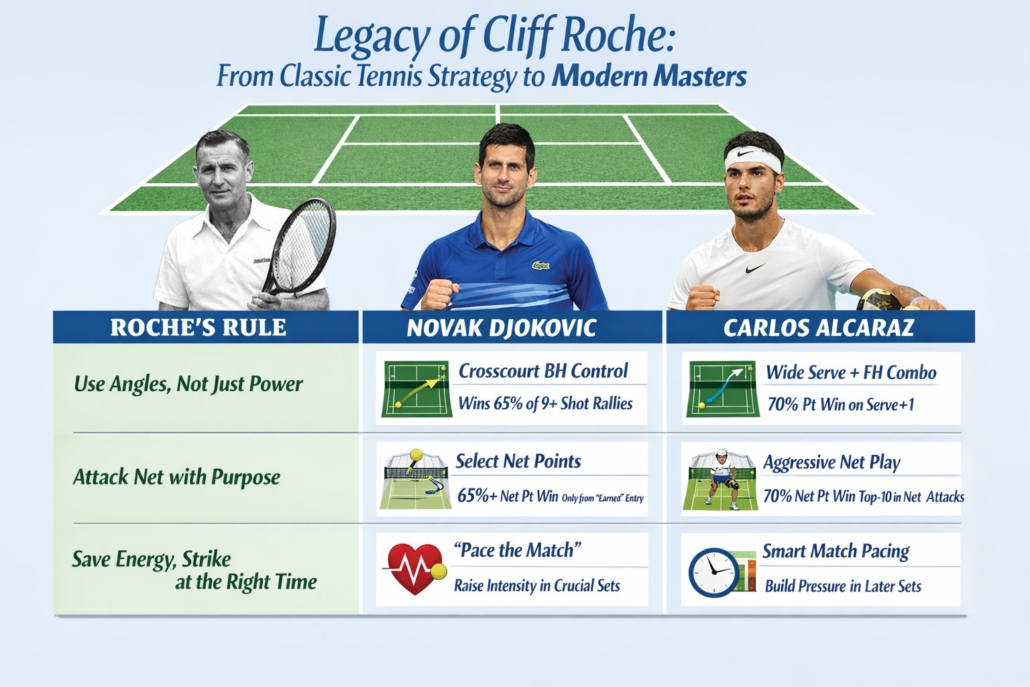
As they say — the more things change, the more they stay the same.


