

Bolt6: Hawk-Eye Evolves
Bolt6: Hawk-Eye Evolves
The Australian Open’s adoption of Bolt6 is best understood as a change in system design rather than a step change in officiating accuracy.
The core function—automated line calling—remains unchanged in purpose. What has changed is the scope of the underlying data model and how that data can be reused.
Bolt6 was developed by a small technical team. Founded in 2021, the company brought together engineers with backgrounds in computer vision, motion tracking, biomechanics, and cloud systems. The original team—six core contributors—designed Bolt6 around continuous motion modelling rather than event-based officiating, which is reflected in both the system architecture and the name itself (six degrees of freedom). The platform has since been refined through live evaluation with major tennis bodies and Grand Slam events, with Tennis Australia playing a central role in operational testing and deployment.
Design Focus: Events Versus Motion
Earlier officiating systems, including Hawk-Eye, were designed to resolve discrete events. Their role was to determine the outcome of specific moments, most notably whether a ball landed in or out.
Bolt6 retains that capability, but it is organised around a continuous motion model rather than isolated events. Both ball and player movement are tracked and maintained as part of an ongoing state.
This design choice does not alter the officiating decision itself, but it changes what else the system can support without additional capture.
Name/Technical Framing
The name “Bolt6” reflects the system’s technical framing.
-
“Bolt” refers to short-duration, high-speed human movement.
-
“6” refers to six degrees of freedom: three translational and three rotational axes, the standard representation used in motion analysis.
The intent is descriptive. The system is designed to model player movement in full spatial and rotational terms, with officiating outputs derived from that model.
Functional Consequences
Because Bolt6 maintains a continuous representation of motion, the same data can be applied to several uses:
-
Line-calling decisions
-
Basic reconstruction of player movement
-
Simplified visual overlays for broadcast
-
Movement-based performance measures
These functions are not independent systems. They are alternative views of the same data set.
This reduces duplication and allows incremental additions without re-engineering the core system.
Broadcast and Analytical Use
In broadcast, the effect is limited but practical.
Movement-based measures—such as arm speed during serve motion—can be presented alongside ball-speed readings. This provides additional context for performance without relying solely on replay or interpretation.
The key point is that this information is a by-product of the officiating system, not a separate analytical process.
Operational Characteristics
Bolt6 is cloud-native, which affects how it is maintained rather than how it performs on court.
Updates can be deployed centrally, and functionality can be extended without replacing court-level infrastructure. This supports gradual development and reduces the need for periodic system replacement.
Officiating technology becomes part of the broader tournament technical stack rather than a self-contained service.
Wrap
Bolt6 does not change the purpose of officiating. It changes how officiating data is structured and reused.
-
Previous systems resolved individual events
-
Bolt6 maintains a continuous motion representation
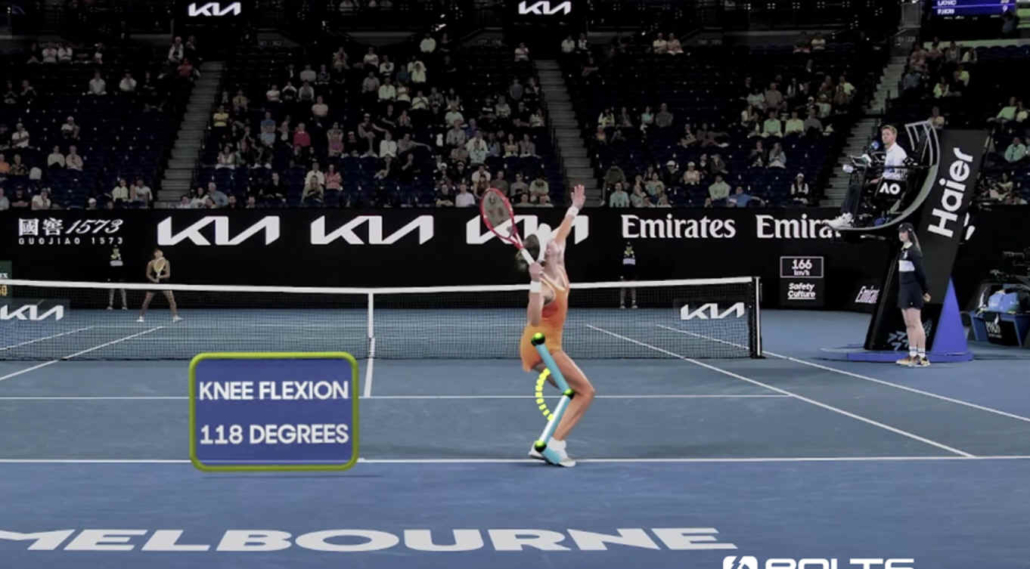
Source: Bolt6
The result is a system that supports officiating first, with limited additional uses enabled by the same data. The significance lies in operational sustainability rather than feature expansion.


