

The Way of the Sword: Transforming Your Serve
The Way of the Sword: Transforming Your Serve
As a tennis coach and lifelong student of performance, I’ve always been drawn to lessons from disciplines outside the court—especially those that offer a deeper understanding of movement, rhythm, and power.
One such discipline is Japanese swordsmanship. Surprising? Perhaps. But hear me out.
Enter Miyamoto Musashi
Miyamoto Musashi, Japan’s legendary samurai and author of The Book of Five Rings, mastered the art of combat not just through skill, but through an economy of movement and internal calm.
Among his lesser-known yet powerful principles was his grip philosophy:
Anchor the sword with the pinky and ring fingers; keep the upper fingers loose.
This small detail enabled:
-
Stability and control from the base of the hand
-
Freedom and fluidity in the wrist and forearm
-
Maximum efficiency with minimal effort
Sound familiar?
It should—because this very principle can elevate your tennis serve to a whole new level.
From Katana to Kick Serve: the Samurai Grip
In serving, your racquet is your blade—a tool of precision, force, and finesse. And just like Musashi’s katana, it must be both anchored and agile, delivering maximum impact with minimal effort.
A katana isn’t wielded with brute strength, but with a blend of grounded control and flowing motion. The same applies to the tennis serve: if you overgrip, you restrict the natural whip of the racquet; if you undergrip, you lose stability and direction.
Musashi solved this centuries ago by teaching warriors to anchor the sword with the pinky and ring fingers, while allowing the upper fingers to remain relaxed—creating a perfect union of structure and suppleness.
This philosophy directly enhances serve performance, especially in terms of power generation, spin production, and fluidity. Below is how to apply Musashi’s grip doctrine to your own serve:
1. Power Generation: Anchor with the Pinky
The serve starts from the ground up, with energy flowing through the kinetic chain—from your legs, through your core, shoulder, arm, and finally into the racquet. Anchoring with the pinky and ring fingers creates a strong, stable base at the very end of that chain, allowing you to transfer force efficiently without overgripping. This subtle leverage point helps stabilize the racquet head while keeping the rest of the arm relaxed, preserving fluidity and maximizing racquet-head speed through contact.
How to Apply:
During your racquet drop and acceleration, apply more pressure with the pinky and ring fingers. This stabilizes your grip and helps direct energy from your legs and core into the ball.
2. Fluid Wrist Snap: Relax the Upper Fingers
A stiff grip chokes your serve’s natural rhythm. Musashi knew that by keeping the upper fingers relaxed, the wrist could flow freely.
How to Apply:
Let the index and middle fingers rest lightly on the handle. This promotes wrist mobility, crucial for generating spin—whether it’s slice, topspin, or kick.
3. Control & Precision: Balance the Grip
A pinky-driven grip supports the racquet head, while relaxed upper fingers allow for subtle adjustments. This harmony between control and finesse is what made Musashi lethal—and it can do the same for your serve.
How to Apply:
Stay relaxed through the toss and into the contact zone. Trust that your lower fingers will control the racquet, freeing your hand for accurate targeting and shape on the ball.
4. Serving Rhythm: Find the Flow
Musashi believed in moving naturally and rhythmically—never forcing a motion. A balanced grip fosters the same relaxed cadence in your serve, preventing rushed mechanics and muscle tension.
How to Apply:
Focus on your grip tension during practice. Feel how a firm pinky grip grounds your motion, while loose upper fingers guide a smoother, more consistent swing.
5. Spin Variety: Unlock Your Arsenal
By relaxing the hand (as Musashi did before unleashing decisive cuts), you allow your wrist to become an extension of intention—carving the ball with the type of spin that fits the moment.
How to Apply:
Keep experimenting with your serve types using this grip structure. You’ll find your racquet head speed improves, and your spin control becomes more intuitive.
Wrap: Samurai Simplicity for Modern Power
Musashi once wrote:
“You should not have any special fondness for a particular weapon. Too much is the same as not enough.”
In tennis, this speaks directly to the danger of over-reliance on rigid technique or overthinking mechanics. The best players adapt, adjust, and flow with their tools—rather than forcing them. Your racquet, like Musashi’s sword, should become an extension of your body, not something you muscle or micromanage.
The pinky-driven grip is a foundational principle, not a rigid rule. It offers stability at the base and freedom at the wrist—enabling a serve that blends power, precision, and disguise without excess effort.
Train soft hands. Anchor with purpose. Swing like a sword.
Let Musashi’s doctrine guide your serve—not through brute strength, but through refined, repeatable mastery that holds up under pressure and adapts to any situation.
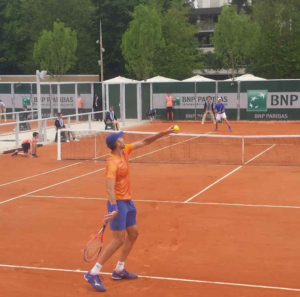
Take a close look at Karlovic’s grip on his serve, captured during his match against Thommo at the French Open a few years ago. It almost resembles a two-finger grip, reminiscent of the way Gonzales used to serve! Photo credit: Tony Reynolds


Leave a Reply
Want to join the discussion?Feel free to contribute!