

Cooper Woods, Olympic Gold & The Power of Ritual
Cooper Woods, Olympic Gold & The Power of Ritual
Cooper Woods did not arrive at the Milano Cortina Winter Olympics as a dominant favourite.
He had never won a World Cup gold. He had not made a final that season. In the first round of qualification, he finished 15th and missed the automatic cut. By his own admission, belief had been fragile.
What he did have was a routine.
The Mentorship That Mattered
Several years earlier, through the Sport Australia Hall of Fame mentoring program, Woods was paired with John Eales.
Eales shared his goal-kicking process — a deliberate system to handle pressure.
Line up the ball. Three steps back. Three across.
Then three internal cues: Head down, Slow,
Cooper Woods, Olympic Gold & The Power of Ritual
Cooper Woods did not arrive at the Milano Cortina Winter Olympics as a dominant favourite.
He had never won a World Cup gold. He had not made a final that season. In the first round of qualification, he finished 15th and missed the automatic cut. By his own admission, belief had been fragile.
What he did have was a routine.
The Mentorship That Mattered
Several years earlier, through the Sport Australia Hall of Fame mentoring program, Woods was paired with John Eales.
Eales shared his goal-kicking process — a deliberate system to handle pressure.
Line up the ball. Three steps back. Three across.
Then three internal cues: Head down, Slow, Follow through
The purpose was not hype. It was simplification.
The kick stopped being about winning or losing. It became about executing a sequence.
Turning Pressure Into Process
Woods adopted the same principle for skiing.
Before each run, he uses short cues to align his focus. As he pushes from the start gate, he says, “Let’s go.” Not as celebration, but as instruction — a commitment to action.
Different sport. Same cognitive challenge.
Under pressure, attention either narrows too much or scatters. Structured pre-performance routines improve consistency under stress . Even simple physical cues — such as a brief left-hand squeeze before serving — have been shown to stabilise accuracy when stakes rise .
The mechanism is clear: Ritual directs attention toward controllables and away from consequences.
Dropping Last
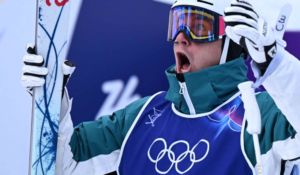
In the Olympic final, Woods dropped last.
Objectively, it is the highest-pressure position in the field. He reframed it as a privilege. Then he skied turn by turn.
He tied Mikael Kingsbury on total score and won gold on the turns component — the most technical scoring category.
It was not dramatic. It was precise.
Why This Matters
Afterwards, Woods spoke about how much he relied on the cues introduced through Eales. He used them throughout the season — especially when confidence was low.
That detail matters. Confidence fluctuates. Emotion shifts with results. Ritual remains stable.
This is the transferable lesson across sports.
A rugby goal-kicking process influenced an Olympic moguls skier. The skills are unrelated. The performance demands are not.
Across disciplines, athletes must:
-
Execute under scrutiny
-
Manage expectation
-
Stay present
Ritual provides structure in those moments.
The Real Takeaway
Woods’ success was not built in a single final run.
It was built through repeated behaviours — small cues practiced often enough that they held under pressure.
The outcome was a gold medal.
The method was routine.
-
Follow through
The purpose was not hype. It was simplification.
The kick stopped being about winning or losing. It became about executing a sequence.
Turning Pressure Into Process
Woods adopted the same principle for skiing.
Before each run, he uses short cues to align his focus. As he pushes from the start gate, he says, “Let’s go.” Not as celebration, but as instruction — a commitment to action.
Different sport. Same cognitive challenge.
Under pressure, attention either narrows too much or scatters. Structured pre-performance routines improve consistency under stress . Even simple physical cues — such as a brief left-hand squeeze before serving — have been shown to stabilise accuracy when stakes rise .
The mechanism is clear: Routine directs attention toward controllables and away from consequences.
Dropping Last
In the Olympic final, Woods dropped last. Objectively, it is the highest-pressure position in the field. He reframed it as a privilege. Then he skied turn by turn.
He tied Mikael Kingsbury on total score and won gold on the turns component — the most technical scoring category.
It was not dramatic. It was precise.
Why This Matters
Afterwards, Woods spoke about how much he relied on the cues introduced through Eales. He used them throughout the season — especially when confidence was low.
That detail matters. Confidence fluctuates. Emotion shifts with results. Routine remains stable.
This is the transferable lesson across sports. A rugby goal-kicking process influenced an Olympic moguls skier. The skills are unrelated. The performance demands are not.
Across disciplines, athletes must:
-
Execute under scrutiny
-
Manage expectation
-
Stay present
Ritual provides structure in those moments.
Wrap
Woods’ success was not built in a single final run.
It was built through repeated behaviours — small cues practiced often enough that they held under pressure.
The outcome was a gold medal. The method was routine!



Leave a Reply
Want to join the discussion?Feel free to contribute!