The Complete Player: Mastering the Three Pillars of Tennis Development
Hitting, playing, and competing in tennis are often misunderstood as one and the same. But each represents a distinct pillar of development, demanding specific skills, targeted training, and a progressive shift in mindset.
Mastery in one phase does not automatically guarantee success in the next. To become a complete player—one capable of winning at higher levels—you must intentionally grow through each stage, refining your technique, deepening your tactical awareness, and building the psychological resilience to perform under pressure.
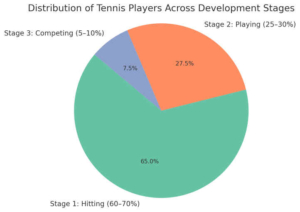
Statistically, the progression narrows dramatically. Roughly 60 to 70 percent of players never move beyond the first stage. They strike the ball well but lack a strategic framework. Around 25 to 30 percent evolve into competent players who understand point construction and tactical variation. Only a small elite—perhaps five to ten percent—reach the third stage, where they can consistently execute under match pressure and adjust in real time.
The same pattern exists in coaching. An estimated 70 to 80 percent of tennis instruction remains focused on stroke production. While technical fluency is necessary, fewer coaches offer the kind of tactical guidance and psychological training required for true competitive development. Less than ten percent of coaches prioritize performance training that bridges the gap between knowing how to hit and knowing how to win.
Stage 1: Learning How to Hit the Ball
This is the technical foundation that supports everything that follows. The goal is to develop repeatable, efficient strokes and movement patterns that can stand up under the physical and time demands of competition. Key training elements include:
-
Clean contact and repeatable swing paths
-
Basic footwork patterns: cross-over step, split step, first step, recovery
-
Consistent contact point and spacing
-
Lower body balance and weight transfer mechanics
-
Use of simple, structured drills: basket feeding, shadow swings, and controlled hitting
-
Focus on body control, not power or deception
This stage emphasizes volume and repetition to build coordination, rhythm, and muscle memory.
This is the least glamorous phase, but also the one that determines whether you’ll be capable of rising to the next level.
Stage 2: Learning How to Play the Game
Once a player can reliably control the ball, they enter the second stage—learning how to play. This is where stroke production becomes decision-making.
Players begin to recognize tactical patterns, construct points, and manipulate tempo and geometry. They learn to adapt to different styles and surfaces while developing a playing identity, whether as an aggressive baseliner, counterpuncher, or all-court competitor. Training becomes more live-ball oriented, with scenario-based drills and feedback loops focused on intention, not just execution.
Stage 3: Learning How to Compete
The third and final stage—learning how to compete—is the most elusive. It’s the stage where players must perform their best when it matters most.
Here, the emphasis shifts to mental routines, emotional regulation, and psychological warfare. Players learn how to manage nerves, handle momentum swings, and recover from adversity.
Tools like breathing techniques, visualization, pre-point rituals, and methods such as the left-hand tennis ball squeeze—a proven technique to reduce choking under pressure—are implemented.
Training at this stage includes competitive sets, pressure simulations, and a deliberate focus on routine-building and decision-making under stress.
Ultimately, mastery in tennis is layered. A player with clean technique but no tactical understanding will lose to smarter opponents. A tactically sound player without composure will unravel in the clutch. And a mentally tough competitor without technical control will be limited in execution. True performance emerges only when all three pillars—hitting, playing, and competing—are developed together.
This progression is not automatic. It must be trained with purpose. The complete player builds the base, sharpens the mind, and hardens the edge.

 20°C
20°C

Vale Big Tony
/in Goss, NewsVale Big Tony
Yesterday, we gathered to celebrate the life of Big Tony — a man whose presence was as solid and generous as the cliffs he loved to climb.
A schoolteacher, bushwalker, climber, and proud father — we met Tony and Jackie on a trip through the Kimberley in 2019. What an adventure that was: four-wheel driving the rugged Gibb River Road from Darwin to Broome, often sleeping on the ground, gazing up at the endless night sky, sharing stories and laughter beneath the stars.
The service at St Stephen’s in Kurrajong, nestled in Tony’s beloved Blue Mountains, was packed to the rafters. The hall overflowed with ex-schoolmates, canoe club members in their bright turquoise jackets, climbers, travelers, and friends from every chapter of his life. A full house for a full life.
Jackie, his beloved wife of 41 years, was the steady heart of the day. Steph, their daughter, delivered a deeply moving tribute — eloquent, brave, and loving. As Rob whispered, “a hard act to follow.” Andrew, Tony’s son, was ever-present — in the recollections, in the warmth of those around him, in the legacy his dad leaves behind.
Wildflowers filled the church and later at the wake at the Kurrajong Bowlo, a fitting echo of the wild beauty Tony loved so dearly.
Both of us felt embraced by the community, and honored to be part of such a meaningful farewell.
Rest well, Big Tony. You lived large, loved deeply, and reminded us all to look up at the stars a little longer.
Reinventing Mixed Doubles: A New Era at the US Open
/in Goss, News, Tournaments25 Teams Enter Reimagined US Open Mixed Doubles Championship
A total of 25 teams have officially entered the reimagined US Open Mixed Doubles Championship.
On July 28, the top eight teams will earn direct entry into the main draw—not for their doubles prowess, but based purely on their combined singles rankings. That’s right—no track record as a team, no doubles chemistry required. Just individual star power.
This format flips the script, spotlighting raw talent and high-profile names over tested partnerships. It’s less about traditional doubles strategy, more about marquee matchups and unexpected pairings. In short, it’s part tournament, part celebrity exhibition.
The remaining eight teams will be selected via wild card, with announcements coming soon. If you thought mixed doubles was all finesse and teamwork—think again.
US Open Mixed 2025
US Open 2025
/in TournamentsEvent Title: 2025 US Open – Grand Slam in NYC
Dates: August 24 – September 7, 2025
Location: USTA Billie Jean King National Tennis Center, Flushing Meadows, NY
Surface: Hard Court (DecoTurf)
Overview:
The 2025 US Open kicks off Sunday, August 24, for a 15-day stretch of Grand Slam action—marking the first weekend start in tournament history. Fans can expect electrifying matchups, revamped mixed doubles, and marquee finals on September 6 (Women’s) and 7 (Men’s).
Key Highlights:
Extended format: First-round matches now span Sunday–Tuesday.
Mixed Doubles: Two-day format with 16 teams and $1M prize pool.
Open Pride Day: August 28 celebrates inclusivity in tennis.
More Info & Tickets:
Visit the official site: usopen.org
Scheffler’s Masterclass: Finding A Way
/in News, Psychology, WhispererScheffler’s Masterclass: Finding A Way
Whether in golf or tennis, one truth holds firm: mastery is always just out of reach.
Even the greatest players rarely fire on all cylinders at once. Precision, power, touch, mental clarity — getting every pillar to align is the exception, not the rule. There are days when it all feels effortless. But even for the best, that feeling never lasts long.
Champions aren’t defined by perfection. They’re defined by what they do when perfection isn’t an option.
On a windswept Sunday at Royal Portrush, Scottie Scheffler showed exactly what that looks like. He missed fairways. The conditions were brutal. The crowd roared for Rory. Then came the stumble — a double bogey on 8. But Scheffler didn’t flinch. He bounced back with a birdie at 9, stayed locked in, and closed with four rounds in the 60s.
When his putting faltered, his ball-striking carried him. When the pressure mounted, he didn’t panic — he adapted. As Rory McIlroy said:
And that’s what competitive tennis demands, too — the mindset of a complete player.
How Do Tennis Champions Find a Way?
They adapt — not by waiting for things to click, but by taking control of what they can.
They grind through long rallies when their weapons aren’t landing.
They adjust their targets and margins, staying patient without losing intent.
They disrupt patterns, mix spins, and test for cracks in their opponent’s game.
They stay anchored — in footwork, in breath, in ritual — even when everything in them wants to unravel.
Like Scheffler pacing between shots with quiet focus, great tennis players turn inward between points.
They don’t chase momentum. They create it — one disciplined decision at a time. One point at a time.
The Essence of Competing
Competing at your best has never been about flawless execution. It’s about something far more demanding — refusing to go away.
It’s staying in the fight, no matter how off your timing feels, how rough the conditions get, or how loudly the scoreboard screams against you. Because competition doesn’t reward perfection — it rewards persistence. It favors the player who keeps showing up, who keeps swinging, who refuses to give in.
When your game feels off, you don’t need to be spectacular — you need to be smart. Tighten your targets. Simplify your patterns. Shrink the court if you must. But stay present. Stay stubborn.
When your opponent catches fire, don’t panic — respond. Absorb their momentum. Break their rhythm. Reclaim your space, one choice at a time.
And when pressure builds, lean in. Breathe slower. Move sharper. Let the moment focus you, not fracture you.
Champions aren’t fearless — they’re just willing to feel the fire and keep going.
In the end, brilliance might win the highlight reel. But it’s grit that wins the match.
Find a Way. That’s the mark of a complete player.
Read more on what it takes to be coming a complete tennis player
ITF MT700 NSW Championships
/in TournamentsITF MT700 NSW Championships
2–6 October 2025 | Wests Tennis Centre, Leumeah
Tournament Venue
Wests Tennis Centre — the premier tennis destination in South West Sydney — proudly hosts the ITF MT700 NSW Championships.
Facility Highlights
The Science Behind Easy Power
/in Balance, News, Psychology, WhispererEasy Power: Unlocking Effortless Force
The Science: Power Without Effort
Advanced tennis isn’t about swinging harder — it’s about swinging smarter. That’s the essence of Easy Power, as illustrated in Ian Westermann’s YouTube video at Wimbledon 2025, when Marin Čilić faced rising star Jack Draper. Čilić didn’t try to outmuscle Draper. Instead, he managed his swing tempo — hovering around 80% of max speed — and emphasized timing, balance, and core engagement. His strokes were deep, heavy, and unforced, not because he swung harder, but because he swung with precision and complete body integration.
That’s Easy Power: efficient, composed, and devastatingly effective.
What Is Easy Power?
Easy Power is not about swinging softly — it’s about swinging in control. It’s a refined tempo that:
Engages your legs, hips, and core
Maintains balance and stability throughout the motion
Sequences your movement fluidly from the ground up
The ideal tempo? 80% of your full effort. This allows for faster recovery, cleaner contact, and more sustainable power.
From Control Comes Force
Performance coach Gavin MacMillan has long emphasized this core principle:
His training focuses on proprioception, balance, and joint sequencing. Athletes generate more speed and power after reducing tension and improving control. This aligns perfectly with Easy Power — smoother movements yield cleaner force.
Proprioception — a fancy word for your body’s ability to sense its position and movement in space — is what allows you to stay balanced, adjust mid-motion, and strike with precision without consciously thinking about it.
Balance: The Bedrock of Easy Power
Power leaks when balance is lost. To unlock Easy Power, you must start with a stable base. Every effective groundstroke begins from the ground up — through your legs, hips, and torso — and balance is what holds that kinetic chain together.
To build functional balance:
Prep & Transition Steps – Position you in a balanced, athletic posture before each swing
Cross-Over Steps – Develop lateral control and hip mobility for rotational force
Stable Contact Stance – Neutral or open, your stance must ground you to transfer energy efficiently
Balance isn’t just part of the swing — it’s the platform that makes power possible.
Getting into “The Zone”
One of the greatest advantages of Easy Power is its ability to put you in the Zone — that state of optimal performance where focus is sharp, effort feels light, and execution becomes automatic. As Tim Gallwey described in The Inner Game of Tennis, this is when the conscious mind steps aside and the body performs with natural rhythm and instinct.
Why the 80% tempo helps:
You’re less rushed — movement and timing feel unforced
You’re more rhythmic — swing flow improves consistency
You trust your training — your body takes over, without second-guessing.
The Hidden Bonus: No More Tennis Elbow
The most overlooked benefit of Easy Power? Injury prevention.
Overhitting puts excessive strain on your arm, especially the elbow and wrist. Most cases of tennis elbow stem from poor body mechanics and muscling the ball.
By managing your swing and shifting the workload to your core and lower body, you minimize stress on vulnerable joints. Easy Power doesn’t just boost performance — it preserves your longevity on court.
Wrap
Easy Power is not less power — it’s smarter, safer, and more effective power.
By managing your swing tempo, grounding your balance, and engaging your core, you tap into your body’s natural strength — without overexertion or injury. You swing with intention. You move with flow. You compete with calm authority.
What Tennis Players Can Learn from a Tour de France Champion
/in News, Psychology, WhispererWhat Tennis Players Can Learn from a Tour de France Champion
At first glance, cycling and tennis seem worlds apart — one a battle of wattage over mountains, the other a clash of racquets on painted rectangles.
But look deeper into the mindset and story of Tour de France champion Tadej Pogačar, and you’ll uncover profound lessons for tennis players striving for excellence.
1. Play With Lightness, Even at the Highest Level
Pogačar is the most dominant rider of his generation — and yet, he approaches his sport with a smile, a selfie, and a spirit of play. Despite the stakes, his laidback demeanor is his strength, not a weakness.
Tennis takeaway: High performance doesn’t require high tension. Cultivate calm. Practice mindfulness, like breath control and personal rituals. Under pressure, recall the joy of the game — the rhythm, the rally, the reason you started.
2. Win and Lose Like a Champion
Pogačar’s grace in defeat — acknowledging rivals, riding without regret — reflects his early upbringing where winning was rare, and effort was celebrated. That mindset, forged in family games and chores, gave him emotional resilience.
Tennis takeaway: Compete with full intensity but detach from outcomes. Win or lose, reflect on your performance and commitment. This resilience allows you to bounce back stronger, without the psychological cost of choking.
3. Obsession Beats Ambivalence
Pogačar wasn’t pushed into greatness — he followed his brother into sports out of curiosity, then surpassed him with sheer focus. His all-in mentality — choosing cycling over everything — made the difference.
Tennis takeaway: Discipline is easier when driven by passion. Small wins snowball!
4. Joy in the Sufferfest
Pogačar doesn’t just endure climbs; he thrives in them. He describes the brutal mountain stages as “fairytales.” Why? Because he’s fully present, engaged in the moment, and aligned with his purpose.
Tennis takeaway: Channel this mindset into conditioning sessions and long match play. Embrace the discomfort of footwork drills and agility work. View the grind as a privilege, not punishment.
5. Family and Foundations Matter
Pogačar’s support system was grounded in humility and hard work. His parents didn’t push performance — they encouraged effort, balance, and consistency. This emotional foundation insulated him from pressure.
Tennis takeaway: Surround yourself with people who value you beyond wins. Maintain perspective. Long-term success flows from grounded confidence, not external approval.
Key Takeaways for Tennis Competitors
Smile under pressure: A light heart is a competitive edge.
Compete fully, detach emotionally: Control what you can — your effort and mindset.
Train like it’s your passion project: Systematize habits, enjoy the process.
Love the pain: View hard work as meaning, not misery.
Build your tribe: A stable support network fuels your rise.
When you step on court next, channel the energy of a cyclist flying up Hautacam — fearless, focused, and loving every second. Because sometimes, the greatest tennis lessons come from outside the court.
Mastering the Three Pillars of Tennis Development
/in News, Training, WhispererThe Complete Player: Mastering the Three Pillars of Tennis Development
Hitting, playing, and competing in tennis are often misunderstood as one and the same. But each represents a distinct pillar of development, demanding specific skills, targeted training, and a progressive shift in mindset.
Mastery in one phase does not automatically guarantee success in the next. To become a complete player—one capable of winning at higher levels—you must intentionally grow through each stage, refining your technique, deepening your tactical awareness, and building the psychological resilience to perform under pressure.
Statistically, the progression narrows dramatically. Roughly 60 to 70 percent of players never move beyond the first stage. They strike the ball well but lack a strategic framework. Around 25 to 30 percent evolve into competent players who understand point construction and tactical variation. Only a small elite—perhaps five to ten percent—reach the third stage, where they can consistently execute under match pressure and adjust in real time.
The same pattern exists in coaching. An estimated 70 to 80 percent of tennis instruction remains focused on stroke production. While technical fluency is necessary, fewer coaches offer the kind of tactical guidance and psychological training required for true competitive development. Less than ten percent of coaches prioritize performance training that bridges the gap between knowing how to hit and knowing how to win.
Stage 1: Learning How to Hit the Ball
This is the technical foundation that supports everything that follows. The goal is to develop repeatable, efficient strokes and movement patterns that can stand up under the physical and time demands of competition. Key training elements include:
Clean contact and repeatable swing paths
Basic footwork patterns: cross-over step, split step, first step, recovery
Consistent contact point and spacing
Lower body balance and weight transfer mechanics
Use of simple, structured drills: basket feeding, shadow swings, and controlled hitting
Focus on body control, not power or deception
This stage emphasizes volume and repetition to build coordination, rhythm, and muscle memory.
This is the least glamorous phase, but also the one that determines whether you’ll be capable of rising to the next level.
Stage 2: Learning How to Play the Game
Once a player can reliably control the ball, they enter the second stage—learning how to play. This is where stroke production becomes decision-making.
Players begin to recognize tactical patterns, construct points, and manipulate tempo and geometry. They learn to adapt to different styles and surfaces while developing a playing identity, whether as an aggressive baseliner, counterpuncher, or all-court competitor. Training becomes more live-ball oriented, with scenario-based drills and feedback loops focused on intention, not just execution.
Stage 3: Learning How to Compete
The third and final stage—learning how to compete—is the most elusive. It’s the stage where players must perform their best when it matters most.
Here, the emphasis shifts to mental routines, emotional regulation, and psychological warfare. Players learn how to manage nerves, handle momentum swings, and recover from adversity.
Tools like breathing techniques, visualization, pre-point rituals, and methods such as the left-hand tennis ball squeeze—a proven technique to reduce choking under pressure—are implemented.
Training at this stage includes competitive sets, pressure simulations, and a deliberate focus on routine-building and decision-making under stress.
Ultimately, mastery in tennis is layered. A player with clean technique but no tactical understanding will lose to smarter opponents. A tactically sound player without composure will unravel in the clutch. And a mentally tough competitor without technical control will be limited in execution. True performance emerges only when all three pillars—hitting, playing, and competing—are developed together.
This progression is not automatic. It must be trained with purpose. The complete player builds the base, sharpens the mind, and hardens the edge.
Why UTR Ratings Are Misleading
/in News, Tournaments, WhispererWhy UTR Ratings Are Just As Misleading as Golf’s Rankings
Jon Rahm is ranked world No. 72. Cameron Smith is 202. Yet both are major champions. These aren’t obscure names—they’re top-tier talents who’ve dominated on golf’s biggest stages. But thanks to the absurd exclusion of LIV events from the Official World Golf Rankings (OWGR), their current rankings paint a totally false picture.
Sound familiar? It should—because tennis has its own version of this misdirection: the Universal Tennis Rating (UTR).
The Illusion of Objectivity
On paper, UTR sounds fair—rating players solely based on who they beat and how competitive their matches are. But in reality, UTR is shaped by access, exclusivity, and systemic blind spots, just like OWGR. If you’re playing in isolated leagues or tournaments that don’t feed into the UTR ecosystem—like LIV in golf—your rating won’t reflect your true ability.
This makes the UTR an incomplete and exclusionary measure, not an accurate representation of the competitive landscape.
UTR’s Hidden Biases
Reward bravery over safety – Encourage juniors to take risks, play up divisions, and compete without fear of losing points.
Celebrate learning, not just winning – Focus on growth from tough matches, new tactics, and developing all-court skills.
Prioritize challenges over comfort – Select tournaments and training environments that stretch players, even if results suffer temporarily.
The result? A distorted “ranking” that ignores context, just as OWGR fails to reflect Rahm or Smith’s elite status due to non-recognition of LIV events.
The Core Problem: Gatekeepers
In both tennis and golf, rankings are dictated by gatekeepers. In OWGR, it’s the PGA and DP World Tour blocking LIV results. In UTR, it’s a limited approval of what counts as “valid” competitive data.
These systems aren’t measuring performance as much as validating participation in an elite club.
What It Means for Tennis
If tennis relies too heavily on UTR to determine tournament entry, seeding, or development paths, we risk marginalizing deserving players—just like the majors might exclude Rahm or Smith in future years.
Talent doesn’t vanish because the algorithm doesn’t track it. Performance doesn’t become irrelevant because it happened outside a system’s walls.
Let’s Learn from Golf’s Mistake
World rankings should reflect the world.
Just as golf fans now laugh at a system that ranks Rahm and Smith behind names they’ve never heard of, tennis needs to rethink the credibility it assigns to UTR.
Until UTR becomes truly universal—and inclusive of all valid play—it should be seen for what it is:
Let’s stop confusing algorithmic precision with competitive accuracy.
The best aren’t always the highest-rated—ask Jon Rahm. Or Cameron Smith. Or that 6.5 UTR player who just smoked a 9.3 in three tight sets.
New Recovery Edge Backed by Sports Science
/in News, Recovery, Tennis4Life, WhispererNew Recovery Edge Backed by Sports Science: Probiotics + Casein at Night
A compelling new study highlighted in the Sports Performance Bulletin—“The Protein–Probiotic Connection: A Match Made in Heaven?” —points to a potentially game-changing edge for recovery and performance.
Here’s what the latest research shows:
In a controlled trial with elite soccer players, 20g of micellar casein combined with a multi-strain probiotic taken before sleep led to significantly greater improvements in strength, power, and muscular endurance than either supplement on its own.
Casein provides a slow-release protein source overnight, fueling sustained muscle repair during sleep.
Probiotics enhance nutrient absorption and reduce systemic inflammation, further amplifying protein utilization and recovery outcomes.
These findings align with current performance nutrition trends that emphasize nighttime protein strategies and gut microbiome optimization for athletes in high-load training environments.
Why this matters for tennis players
This approach targets Delayed Onset Muscle Soreness (DOMS)—the deep muscle fatigue and stiffness that kicks in 12–72 hours after intense training or match play. DOMS is especially common after explosive movements, long rallies, or strength sessions. Reducing DOMS = better recovery, quicker turnaround, and higher consistency on court.
This research-backed strategy may offer a recovery edge for those pushing hard through tournaments, strength training cycles, or multi-session days.
If you’re competing regularly—matches, strength sessions, or back-to-back practices—this combo could offer a simple, evidence-based way to enhance recovery and readiness.
Reference: “The Protein–Probiotic Connection: A Match Made in Heaven?” – Sports Performance Bulletin (2025)
Citation: Pre-sleep casein ingestion with probiotic strains improves anaerobic power, lower-body-specific strength, and power performance in soccer players, Journal of the International Society of Sports Nutrition, 2025, published May 12; Volume 22, Issue 1, Article 2505184
Sinner’s Wimbledon Masterclass: Serve +1 Strategy
/in News, Serve, Strategy, WhispererSinner’s Wimbledon Masterclass: Serve +1 Strategy
Jannik Sinner’s first Wimbledon title was a clinic in modern tactical execution. Facing Carlos Alcaraz — a player known for variety, finesse, and improvisation — Sinner imposed a relentless baseline rhythm built around the Serve +1 strategy, bending the match to his terms with clinical precision. But this wasn’t just a tactical win. The unusually hot English summer fundamentally reshaped the court conditions — transforming Wimbledon’s grass into something far more familiar to Sinner: a fast, hard-hitting surface.
Hard-Court Conditions on Grass
Wimbledon’s grass typically favors short points, touch volleys, and low slices. But under the blistering July sun, the courts dried out and hardened, accelerating ball speed and flattening out bounce. This shift muted the effect of Alcaraz’s signature variety — especially his drop shots and low slices — while increasing the pace of play.
Result? A grass-court match that played like a hard-court.
Serve +1: Designed for Speed and Precision
Sinner capitalized with a textbook Serve +1 formula:
First-serve percentage jumped from 55% to 67%
Forehand aggression off the return became automatic
Court positioning stayed tight to the baseline, robbing Alcaraz of time
With Alcaraz unable to disrupt rhythm through touch or angles, the match became a banging contest.
The Turning Point
Despite a near-flawless first set, Sinner found himself a set down. Alcaraz’s ability to conjure magic from awkward positions — especially with slices and drop shots — initially left Sinner reacting.
Then came the shift. Sinner’s first-serve efficiency surged, and he began hunting forehands immediately after serve, flipping the dynamic and taking control of rallies from the outset.
The numbers back it up. As the match progressed, Sinner’s Serve +1 efficiency became even more pronounced. He increased his attack percentage from 25% in the first set to 38% in the second and 40% in the third, reflecting not just a rise in first serves landed, but also in how effectively he followed them up with aggressive forehands.
By the fourth set, he was winning 47% of baseline points, a figure that flipped the script on Alcaraz, who had previously dominated grass with variety and control.
Serve +1 in Action: Control the Tempo
At its core, Serve +1 is simple but deadly:
Start with a reliable first serve to stretch or jam the returner
Move into the court to position for a forehand
Choose your target — inside-out or inside-in — and commit
Sinner executed this pattern ruthlessly and relentlessly. He didn’t wait for rhythm — he created it, repeatedly striking clean forehands off shallow returns to dismantle Alcaraz’s patterns.
Out-Alcarazing
The true breakthrough wasn’t just on serve — it was how Sinner handled second serves:
He stayed aggressive, both serving and returning
He turned Alcaraz’s second serve into a launchpad for plus-one aggression
His second-serve win percentage climbed, outpacing Alcaraz’s by the final two sets
Each aggressive return disrupted Alcaraz’s ability to build points — a subtle, sustained form of pressure that paid dividends.
Hard Court on Grass
Why did this strategy work so well?
Alcaraz’s drop shots repeatedly misfired, partly due to Sinner’s court coverage and balance
With touch neutralized, baseline rallies defined the match
Sinner’s footwork and balance — honed for hard court — allowed him to explode into shots without overplaying
Sinner didn’t just adjust to the surface — he used it to full advantage.
Wrap
Serve +1 isn’t just a strategy — it’s a mindset. Be first. Be decisive. Be in control.
Stringing Isn’t an Afterthought
/in News, Strategy, WhispererStringing Isn’t an Afterthought—It’s How You Control the Ball
In competitive tennis, equipment choices are often focused on racket frames—weight, balance, and head size. Yet, one of the most significant contributors to performance is often overlooked: string selection and tension. For players who value precision, consistency, and adaptability, strings are not merely accessories—they are central to controlling how the ball behaves off the racket.
At Wimbledon 2025, the role of stringing was on full display. Over 6,400 rackets passed through the tournament’s stringing center, operated by Babolat. A team of 25 stringers worked continuously from early morning through the end of play, fulfilling player-specific stringing requests that often changed mid-match. Runners covered more than 17 kilometers per day to ensure timely delivery of restrung rackets to courts across the All England Club. This level of detail reflects how top players manage tension and string type as part of their tactical preparation.
Understanding Tension
String tension directly affects how the ball leaves the strings:
Higher tension (25+ kg / 55+ lbs) offers greater control and a lower launch angle, which can be advantageous in hot or fast conditions.
Lower tension (21–23 kg / 46–51 lbs) provides more power and a softer feel, often beneficial in cooler temperatures or on slower surfaces.
Some players go outside this range for specific effects. Adrian Mannarino, for example, has used tensions as low as 8.6 kg to create a trampoline-like response.
To manage changing conditions during a match or across a tournament, players often carry several rackets, each strung at slightly different tensions. Small adjustments—often as little as half a kilogram—can significantly affect ball control, especially at higher levels of play.
Hybrid Stringing: Balancing Control and Comfort
Many competitive players now use hybrid string setups to balance durability, spin, and feel. This typically involves polyester in the mains for control and spin, and natural gut or multifilament in the crosses for comfort and power.
This combination allows players to customize string bed response, making it easier to tailor performance to their playing style or the demands of a specific match. It also helps reduce the risk of arm discomfort associated with full polyester beds while maintaining the advantages of spin generation and durability.
Small Details, High Impact
At the professional level, even seemingly minor preferences—like knot positioning, stencil placement, or ink color—are considered part of the preparation. Players develop routines around how their rackets are strung and presented. While these choices may not directly impact string performance, they support consistency and confidence in match conditions.
Implications for Competitive Players
Competitive players—whether on the tournament circuit or in high-level league play—can benefit from adopting a more structured approach to stringing. Key recommendations include:
Track your setup: Record string type, tension, and match conditions. Note how the ball feels and performs under pressure.
Adjust tension with environment: Use tighter strings in warm or fast conditions and looser tensions in cooler, slower environments.
Experiment with hybrids: If you’re seeking more spin or more comfort, hybrid stringing can provide a practical balance.
Re-string consistently: Loss of tension over time can impact feel and performance. Build a restringing schedule based on hours played or number of sessions.
Wrap
Stringing is not a postscript to performance—it’s a central component of preparation. Understanding how tension and string composition influence ball behavior enables players to make informed decisions that directly affect match outcomes.
For those looking to improve consistency and control, especially under match pressure, thoughtful string management is not optional. It’s foundational.
Read more: A Good String Job Can Manage Your Limitations
No Singular Pathway: Player Development Needs Rethinking
/in News, Training, WhispererNo Singular Pathway: Player Development Needs Rethinking
This year’s Wimbledon singles final between Jannik Sinner and Carlos Alcaraz showcased two of the game’s brightest players, each reaching the pinnacle through completely different development paths.
Their journeys illustrate an essential truth about tennis development: There is no singular pathway to the top.
Two Roads to Centre Court
Jannik Sinner – The Challenger Route
At just 13, Sinner left behind a promising skiing career to pursue tennis full-time with Riccardo Piatti. Unlike most juniors, he skipped the traditional pathway of ITF junior tournaments and moved straight into the Challenger circuit as a teenager. Facing experienced professional players early taught him resilience and forced him to adapt tactically under real match pressure. His game is built on efficient, linear hitting mechanics with exceptional balance and stability – foundations that allow him to take time away from opponents while maintaining control. In many ways, Sinner is very much an improved version of Djokovic, combining similar movement efficiency and defensive skills with even greater baseline firepower.
Carlos Alcaraz – The Integrated Junior-ATP Route
Carlos Alcaraz followed a more traditional yet equally demanding route. Under Juan Carlos Ferrero’s guidance, he dominated junior ITF events while gradually integrating Futures and Challenger tournaments into his schedule. His development prioritised explosive athleticism, heavy topspin aggression, and tactical versatility. Similarly, Alcaraz can be seen as an improved version of Ferrero, combining his mentor’s aggressive baseline style with superior volleys and a true all-court game. His style reflects the multidimensional demands of modern and future tennis, allowing him to defend like Nadal, attack like Federer, and seamlessly transition to net within the same point.
What Both Journeys Teach Us
Despite their different routes, Sinner and Alcaraz demonstrate the same core qualities required for success at the highest level:
Resilience under adversity: Both players have proven they can endure physical and mental challenges without losing focus or confidence.
Technical excellence built on balance and efficiency: Their strokes are not only powerful but mechanically sound and energy-efficient, enabling them to handle the intense demands of elite tennis.
A mindset centred on continuous improvement: Each player is deeply committed to analysing their game, refining their skills, and seeking even the smallest gains to keep evolving.
Comparing Today’s Game with Future Forecast
To coach players effectively for long-term success, it is crucial to understand how today’s game differs from what the sport will demand in the next decade.
Final Whisper
There is no single path to success in tennis. Some players will thrive through national tournaments. Others will progress by challenging themselves against stronger, older players without focusing on rankings.
But one mindset remains essential: Coaching must prepare them for the game that doesn’t exist yet.
This year, Sinner’s Challenger journey and Alcaraz’s integrated junior-ATP pathway led them to the same destination – Centre Court at Wimbledon.
For your players, the destination might be different, but the principle remains the same: When your coaching builds skills for the future game, your won’t just be ready – you’ll be ahead of the game.
For the Average Player: Focus Where It Counts
If you’re an average player, read this with your own development in mind. Many of these skills don’t need to be perfected – applying the 80/20 principle means focusing on the few key areas that will give you the greatest results with the least wasted effort.
Knowledge is power. Understanding where to direct your focus can make a real difference in your progress – not just in your tennis, but also in the confidence and life skills you build along the way.
Money Can’t Buy Talent: The Tale of Bill Ackman and the Wizard of Tennis
/in News, Tennis4Life, WhispererMoney Can’t Buy Talent: The Tale of Bill Ackman and the Wizard of Tennis
Once upon a time, there was a powerful Wall Street titan named Bill Ackman.
He moved markets with a single decision. He shaped political debates with a single tweet. His life was defined by strategic wins, leveraged deals, and intellectual dominance.
But hidden beneath the tailored suits and market forecasts was a quiet dream: to conquer tennis. “I’ve mastered finance,” he thought. “Surely I can master tennis too.”
So this week, he packed his gold-embroidered tennis kit and travelled to Newport, Rhode Island, to play in the prestigious Hall of Fame Open.
At his side stood Jack Sock, a true champion with Wimbledon titles behind his name. Jack earned his place with a wildcard granted for past glory.
As for Bill? His reputation bought him a ticket to play alongside Sock, his appearance met with polite applause and quiet curiosity.
But waiting for him there was the Wizard of Tennis. This Wizard was ancient and silent. His robes were woven from grass blades and chalk dust. He did not care about billions under management, social media followers, or political influence. The Wizard only cared about footwork. Balance. Timing. Reaction under pressure.
Bill stepped onto the court with confidence. His first return dribbled onto his own side. His second hit the net with a dull thud. His serves turned into double faults and errors.
All his usual advantages failed him. Money didn’t help. Connections didn’t help. Strategy decks didn’t help. Because tennis, like many crafts, has its own rules.
It rewards preparation, repetition, resilience, and humility under pressure.
When the match ended, Bill bowed his head and said, “I understand now. In business, I can buy what I want. But here, your magic must be earned.”
And so he returned to Wall Street, carrying with him a lesson far greater than any quarterly return: Talent can’t be bought.
In tennis, as in leadership, titles aren’t purchased. They are earned, point by point, through discipline, courage, and the quiet hours of practice when no one is watching.
Let this story remind you: While reputation may open doors, it’s skill and consistency that keeps you in the game.
Breaking the Injury Cycle: Anisimova
/in News, Training, Trident, WhispererBreaking the Injury Cycle: Anisimova
Amanda Anisimova knows what it feels like to carry expectations. At just 17, she reached the French Open semifinal and was hailed as the next American star. But soon after, her world turned upside down when her father and coach died unexpectedly at 52. Her motivation faded, and injuries began to take over her career.
Last night, she reached her first Wimbledon final after beating world No.1 Sabalenka 6-4, 3-6, 7-5. Behind this result is not just her talent but the work of her physio, Shadi Soleymani, who Anisimova credits with a key role in turning things around.
Who is Soleymani?
Soleymani grew up in Sweden, played college tennis in Canada and the US, and trained as a chiropractor with a focus on biomechanics. Before joining Anisimova, she worked with Zheng Qinwen who made a Grand Slam final and won Olympic gold.
Breaking the Cycle of Injury
When Soleymani started working with Anisimova, she noticed something crucial. Amanda was stuck in a loop many athletes know too well:
Ongoing pain stopped her from training properly
Rest led to loss of fitness and conditioning
Competing without preparation caused reinjury
Soleymani assessed her body thoroughly and found weaknesses down her left side, which takes most of the load from serving and backhands. There was scar tissue and muscle imbalance that no one had properly addressed.
“Most of the fitness work she was doing was just putting muscle on top of damaged tissue, covering up problems rather than fixing them,” Soleymani explained.
She used targeted massage and therapy to break down scar tissue, then introduced flexibility and strength work to build stability from within. This wasn’t about quick fixes. It was about giving Amanda a solid base so her body could handle the demands of professional tennis again.
Soon, Amanda went from only being able to practice 50 minutes before pain set in to training up to 3 hours pain-free. This gave her the confidence to trust her body again and train the way she needed to perform at her best.
More Than Just Physical Treatment
Soleymani’s support went far beyond injury treatment:
She noticed Amanda was drinking too much coffee and not enough water, which was affecting her sleep. Cutting out coffee after 6 pm improved her recovery.
While Amanda’s vegan diet was healthy, Soleymani encouraged her to add more dark vegetables and proteins like fish or chicken to maintain her energy for long practices.
She adjusted training loads around Amanda’s menstrual cycle to optimise strength and recovery.
Each morning, Soleymani assessed her and worked with her strength and tennis coaches to plan the day’s sessions based on what her body could handle.
The Evolving Role of Physios
Today, physios on tour do far more than treat injuries:
They help players move efficiently and reduce the risk of injury
They integrate with strength and tennis coaches to build effective, realistic training plans
They provide daily support in what is often an intense and isolating sport.
My Own Story
Physios and massage therapists are also a key part of my Tennis 4 Life program. I make regular visits to see Dave and Nerrisa at Trident in Brookvale. They’ve been instrumental in keeping this old dog on court for the past 15 years. Before that, when we lived in California and competed in the US Nationals – on hard courts, no less, which are really tough on the body – it was Ken and Wilma at the Palisades Tennis Club who kept me going.
Wrap: What This Means for You
You don’t need to be aiming for Wimbledon to benefit from a sports-trained physio or massage therapist.
Whether you’re competing in Badge, playing social doubles, or simply wanting to keep your body moving well into your later years, having someone skilled to treat niggles before they become injuries, improve your movement, and keep you pain-free is invaluable.
Regular treatment can help you:
Release tight muscles before they turn into injuries
Improve mobility and balance to move better on court
Recover faster after matches or training so you stay fresher
Identify small weaknesses before they develop into long-term problems
Too often, players are told that with rest, injuries like tennis elbow will heal themselves. But rest alone rarely fixes the underlying cause. Without proper treatment and guided rehab, pain often returns as soon as you pick up your racket again.
Investing in a good physio or massage therapist is one of the smartest decisions you can make for your tennis life.